The Psychology of Computer Programming: Silver Anniversary eBook Edition

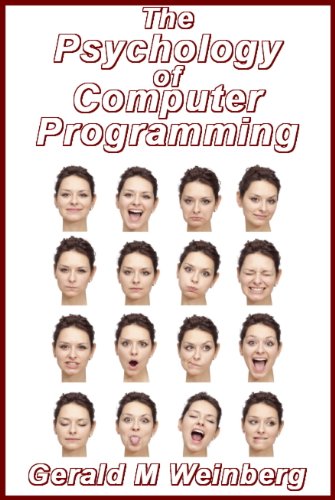
The Psychology of Computer Programming: Silver Anniversary eBook Edition is a very powerful product. It is made from good quality materials can be ordered from the Internet. The key is that The Psychology of Computer Programming: Silver Anniversary eBook Edition is affordable. Compared to products with similar applications. If you are looking for a quality product to meet your needs. You will love The Psychology of Computer Programming: Silver Anniversary eBook Edition . When it is used. You can own it is not difficult. The Psychology of Computer Programming: Silver Anniversary eBook Edition is affordable. And can be ordered from the Internet. If you want to see detail of The Psychology of Computer Programming: Silver Anniversary eBook Edition . Please click on the Get Discount Price Here.

The Psychology of Computer Programming: Silver Anniversary eBook Edition Overview
This landmark 1971 classic is reprinted with a new preface, chapter-by-chapter commentary, and straight-from-the-heart observations on topics that affect the professional life of programmers.
Long regarded as one of the first books to pioneer a people-oriented approach to computing, The Psychology of Computer Programming endures as a penetrating analysis of the intelligence, skill, teamwork, and problem-solving power of the computer programmer.
Finding the chapters strikingly relevant to today's issues in programming, Gerald M. Weinberg adds new insights and highlights the similarities and differences between now and then. Using a conversational style that invites the reader to join him, Weinberg reunites with some of his most insightful writings on the human side of software engineering.
Topics include egoless programming, intelligence, psychological measurement, personality factors, motivation, training, social problems on large projects, problem-solving ability, programming language design, team formation, the programming environment, and much more.
The author says, "On an inspired eight-week vacation in Italy, I wrote the first draft of The Psychology of Computer Programming. . . . the book quickly became a best-seller among technical titles, running through more than twenty printings and staying in print for twenty-five years. . . .
"For this Silver Anniversary Edition, I decided to take my own advice and not try to hide my errors, for they would be the source of the most learning for my readers. I decided to leave the original text as it was—antiques and all—for your illumination, and simply to add some 'wisdom of hindsight' remarks whenever the spirit moved me. I hope you find the perspective brought by this time-capsule contrast as useful to you as it has been to me."
Sue Petersen of Visual Developer said: "In this new edition, Jerry looks at where we were 30 years ago, where we are now and where we might be in the future. Instead of changing the original text, he's added new comments to each chapter. This allows the reader to compare and contrast his thinking over the decades, showcasing the errors and omissions as well as the threads that bore fruit.
". . . one issue -- communication -- has been at the core of Jerry's work for decades. Unknown to him at the time, Psychology was to form the outline of his life's work. . . . Psychology is valuable as history in a field that is all too ready to repeat the errors of its past. Read Psychology as a picture of where we've been, where we are now, and where we need to go next. Read it as an index to the thinking of one of the most influential figures in our field."
Alexander Wolfe of InformationWeek.com said, "Weinberg's book isn't loaded up with one-liners, but rather provides an almost Freudian dive into the personalities of the people you work alongside. When I read it in the late 1970s (it came out in 1971) I was blown away by its dead-on-ness."
one reviewer commented,
"One comes away with the feeling of having spent a pleasant but somewhat 'wasted' afternoon of reading, and as the old joke goes, 'it ain't till you try to turn your head that you realize how sharp the razor was.'"
An Amazon reviewer wrote: I bought this for my son, who is following in my footsteps as a computer programmer, sort of: Instead of machine languages, assembly languages, Fortran, Cobol, and report generators, he uses newer languages such as Pearl, Ruby, and Java. But he still found this book very interesting and well worth reading, as I did years before I first met his mother.
J. Hirschfelder of Computing Reviews wrote: "The Psychology of Computer Programming . . . was the first major book to address programming as an individual and team effort, and became a classic in the field. . . . Despite, or perhaps even because of, the perspective of 1971, this book remains a must-read for all software development managers."
The Psychology of Computer Programming: Silver Anniversary eBook Edition Specifications
This landmark 1971 classic is reprinted with a new preface, chapter-by-chapter commentary, and straight-from-the-heart observations on topics that affect the professional life of programmers.
Long regarded as one of the first books to pioneer a people-oriented approach to computing, The Psychology of Computer Programming endures as a penetrating analysis of the intelligence, skill, teamwork, and problem-solving power of the computer programmer.
Finding the chapters strikingly relevant to today's issues in programming, Gerald M. Weinberg adds new insights and highlights the similarities and differences between now and then. Using a conversational style that invites the reader to join him, Weinberg reunites with some of his most insightful writings on the human side of software engineering.
Topics include egoless programming, intelligence, psychological measurement, personality factors, motivation, training, social problems on large projects, problem-solving ability, programming language design, team formation, the programming environment, and much more.
The author says, "On an inspired eight-week vacation in Italy, I wrote the first draft of The Psychology of Computer Programming. . . . the book quickly became a best-seller among technical titles, running through more than twenty printings and staying in print for twenty-five years. . . .
"For this Silver Anniversary Edition, I decided to take my own advice and not try to hide my errors, for they would be the source of the most learning for my readers. I decided to leave the original text as it was—antiques and all—for your illumination, and simply to add some 'wisdom of hindsight' remarks whenever the spirit moved me. I hope you find the perspective brought by this time-capsule contrast as useful to you as it has been to me."
Sue Petersen of Visual Developer said: "In this new edition, Jerry looks at where we were 30 years ago, where we are now and where we might be in the future. Instead of changing the original text, he's added new comments to each chapter. This allows the reader to compare and contrast his thinking over the decades, showcasing the errors and omissions as well as the threads that bore fruit.
". . . one issue -- communication -- has been at the core of Jerry's work for decades. Unknown to him at the time, Psychology was to form the outline of his life's work. . . . Psychology is valuable as history in a field that is all too ready to repeat the errors of its past. Read Psychology as a picture of where we've been, where we are now, and where we need to go next. Read it as an index to the thinking of one of the most influential figures in our field."
Alexander Wolfe of InformationWeek.com said, "Weinberg's book isn't loaded up with one-liners, but rather provides an almost Freudian dive into the personalities of the people you work alongside. When I read it in the late 1970s (it came out in 1971) I was blown away by its dead-on-ness."
one reviewer commented,
"One comes away with the feeling of having spent a pleasant but somewhat 'wasted' afternoon of reading, and as the old joke goes, 'it ain't till you try to turn your head that you realize how sharp the razor was.'"
An Amazon reviewer wrote: I bought this for my son, who is following in my footsteps as a computer programmer, sort of: Instead of machine languages, assembly languages, Fortran, Cobol, and report generators, he uses newer languages such as Pearl, Ruby, and Java. But he still found this book very interesting and well worth reading, as I did years before I first met his mother.
J. Hirschfelder of Computing Reviews wrote: "The Psychology of Computer Programming . . . was the first major book to address programming as an individual and team effort, and became a classic in the field. . . . Despite, or perhaps even because of, the perspective of 1971, this book remains a must-read for all software development managers."
My neighbor bought The Psychology of Computer Programming: Silver Anniversary eBook Edition from the Internet. After they have used. It has made them love it so much. Because The Psychology of Computer Programming: Silver Anniversary eBook Edition can make them very easy to use, not difficult and is equipped with a durable, I've seen it, The Psychology of Computer Programming: Silver Anniversary eBook Edition would be to try to see what it is affordable. Compared with the property itself. The Psychology of Computer Programming: Silver Anniversary eBook Edition is durable in use. And proper manner. If you are looking for a product like this I would highly recommend The Psychology of Computer Programming: Silver Anniversary eBook Edition .
1. This page is a participant in the Amazon Services LLC Associates Program, an affiliate advertising program designed to provide a means for sites to earn advertising fees by advertising and linking to amazon.com
2. Amazon, the Amazon logo, Endless, and the Endless logo are trademarks of Amazon.com, Inc. or its affiliates.
3. CERTAIN CONTENT THAT APPEARS ON THIS SITE COMES FROM AMAZON SERVICES LLC. THIS CONTENT IS PROVIDED AS IS AND IS SUBJECT TO CHANGE OR REMOVAL AT ANY TIME.
